|
| Fig. 1 Joe Minter, The Price to Vote, The Price to be Human (The Selma March), 1995 Photo: C. Rhodes 15 May 2014 |
Joe Minter's African Village in America
This article was published in French as "L'African Village in America de Joe Minter", in Création Franche, no.53 (December 2020), pp.34-42, available at musee-creationfranche
I publish a version of my article in English here for anglophone readers.
In the late 1980s Joe Minter discovered there were plans to build a Civil Rights Museum in his hometown of Birmingham, Alabama. Although he welcomed this development in a part of the United States with a particularly dark history in respect of its treatment of Black Americans, he quickly realised that the stories it would tell would privilege those of the leaders of the Civil Rights movement. As he put it, "The main characters were left out of the history," namely the "foot soldiers", the thousands of ordinary people who participated in the emancipatory struggle, and without whom the changes made would not have been achieved.* In response to this, Minter resolved to create an outdoor sculpture park or environment. It would tell that other story, beginning with the arrival of Africans in America in the 16th Century. He credits the inspiration and prosecution of his creative mission to Divine forces working through him: "God gave me the mission of art, to link that 400-year journey to the Africans in America ... and I decided to name what I create The African Village in America. It explained the story of the life and struggle we have undergone here in America." Situated on a plot of land next to his home at the edge of the city, and backing on to the New Grace Hill Cemetery, Minter's sprawling creation is at once history, memorial and sacred art.
 |
| Fig. 2 Joe Minter, View of the African Village in America, including African Huts, Warriors and 'The price to Vote'. Photo: C. Rhodes, 15 May 2014 |
Minter was born in 1943. He was the eighth of ten children. His father had served in the US Army in the First World War. But on his return to Birmingham he had been unable to find a job using his skills as an engineer. Instead, he spent his life working as a caretaker. Minter and his brothers also served in the military, returning to be treated as second class citizens: "We have joined a long line of Africans that have put their lives on the line to come back to America and be treated as less than a human being." After his discharge in 1967, Minter worked for more than a decade in jobs requiring skills with metalwork. This was to prove useful later on when he began to make art. Minter received his calling after ill-health forced him to retire. "I knew I had to regroup," he says, "find a way to continue my life and make the best of it." He tried to figure out a way in which he could tell the story of the African American experience and somehow perform an act of social and spiritual healing: "I was living in a place that looked upon Africans as less than human beings," he says, "My ancestors helped build America on the sweat of their backs, in their own blood, in their life, free slave labor, and the way out was death." In spite of having no training or background in art, Minter tells us, "I realised the only way I could preserve this history to hand down to the other generations was through art. Art is a universal thing. My idea was to make the art and put a message with it so that it could heal wounds everywhere. I wanted to send the world a message of God's love and peace for all mankind. I then took on the name, 'Peacemaker'." This was to be an art whose function would be not only expressive, but also curative.
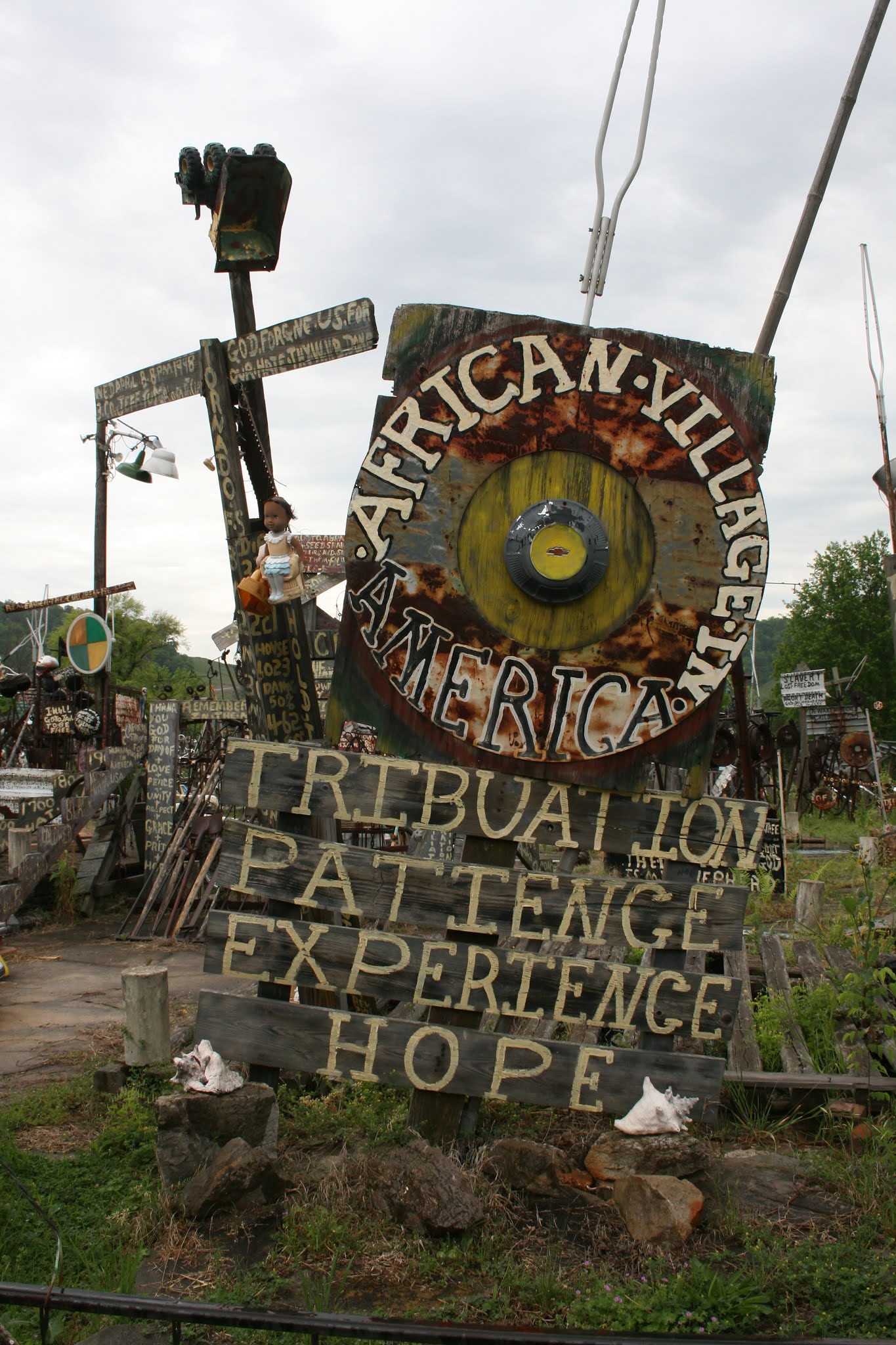 |
| Fig. 3 Joe Minter, Entrance Sign to the African Village in America Photo: C. Rhodes, 6 April 2012 |
Beginning in 1989, Minter created the African Village in America, a complex matrix of sculpture, tableaux, and text, that reveals the African American experience since the arrival of the first slave ships and memorialises key moments and events in that history. The environment consists essentially of two sections. The rear part borders the cemetery. It is devoted to African history and what Laura Bickford describes as, "the values of Black Americans that Minter understands as governing factors in African life in America and African American values." (Bickford 2014: 53) It performs a spatial and cultural continuity between the African past and American present, divided by the traumatic and life-giving medium of water, connecting the old and new homelands. This is symbolised in the park by a sculptural element, Slave Ship Africa, which joins together the two sections. Charles H. Long has noted, "For the Africans forced into slavery, their African culture was dissolved and resurrected in the Atlantic passage. The Atlantic was a cataclysm and a source of renewal of African forms. The Atlantic Ocean simultaneously constitutes a continuity and a discontinuity for the African American." (Long 2001: 466) Elements in the rear section of the park include 'African' huts, as envisioned by Minter, fashioned from found wood and metal, and painted in bright geometric patterns. There are also figures representing warriors, chiefs, and other African types (Fig.4). Symbolically 'African' colours of red, black, green and yellow predominate.
 |
| Fig. 4 Joe Minter, Africans. Photo: C. Rhodes, 6 April 2012 |
The front of the yard consists of assemblages memorialising specific events and themes, intermingled with hand-painted signs that are heavy with Biblical quotation and didactic text. The memorial pieces include some of the most poignant and powerful events in the Civil Rights struggle of the 1960s, most of which were played out broadly in the triangle between Birmingham, Atlanta and Montgomery. For example, there are assemblages dedicated to the Freedom Riders and the Bus Boycott, the bombing of the 16th Street Baptist Church by so-called White Supremacists in 1963, in which four small girls were murdered (Fig.5), the brutal Bloody Sunday attack on peaceful protestors by police on Edmund Pettus Bridge in 1965 (Fig.1), and an evocation of the Birmingham Jail, in which Martin Luther King Jr and countless other activists were detained, and from which Dr King famously wrote his "Letter from the Birmingham City Jail" in 1963 (Fig.7). More recent events include the destruction of the New York World Trade Center in 2001, in which a disproportionate number of Black and members of other American communities of colour lost their lives, and the cataclysmic floods in New Orleans caused by Hurricane Katrina in 2005.
 |
| Fig. 5 Joe Minter, Memorial to those murdered in the 16th Street Baptist Church, Birmingham Photo: C. Rhodes, 6 April 2012 |
There are also memorials to the all-too-common occasions of ordinary people killed in acts of racist violence or through systemic racist neglect: The Murder of Dallo, 2000 ("Male unarmed. Killed by 19 police bullets") and The Death of Jasmine Moore, who died just age 4 in 1999. Thematic assemblages include a tribute to the "Unknown African Soldier" - a figure that Minter regards as a universal for all African Americans who have served. Another text-heavy piece (Fig.6) recalls "the lynching of all our African American ancestors in the USA 1555-1997." Note the tied rope around the neck of the central figure, which functions both as noose and physical connector holding the head in place. Minter's text adds ominously, "America repent, for we are in the last days."
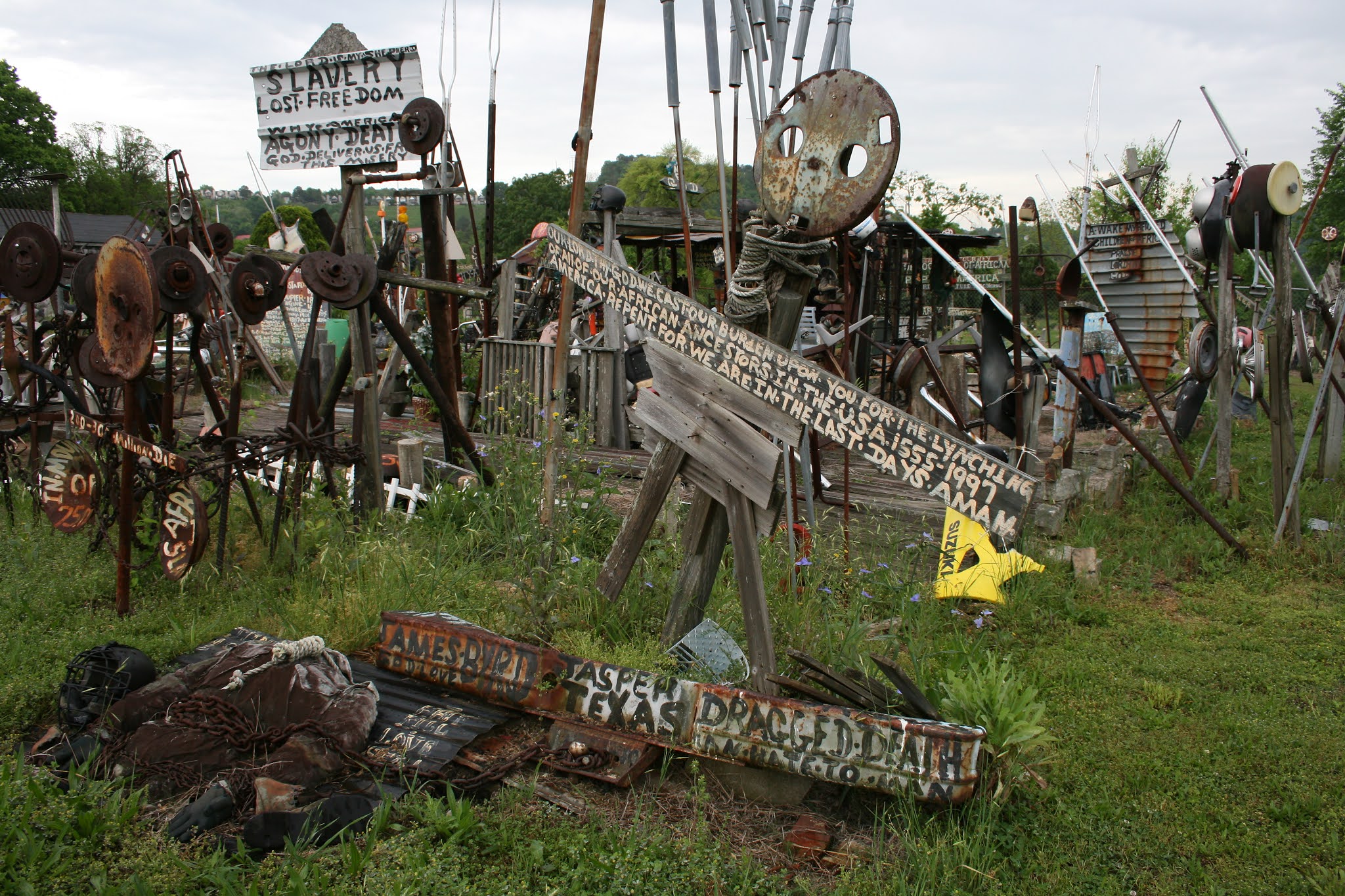 |
| Fig. 6 Joe Minter, Memorial to African American Lynchings 1555-1997. Photo: C. Rhodes, 6 April 2012 |
There is an Apocalyptic quality to much of the African Village in America. it is a warning to all. The Healing that Minter wishes to effect is played out through an encounter between the living viewer and the dead, extending from the symbolic realm in the park into the literal one in the coextensive burial ground. The figure of the artist is here simultaneously revelator, judge and guide. Minter is clear about this: "My prayer as an African artist and for all African artists all over your Earth our Lord thy God is that all artists come together these last days as brothers and sisters in the name of Jesus as one to bring the whole Earth together in the form of love for humanity to clean up the Earth which we have just about destroyed."
 |
| Fig. 7 Joe Minter, Birmingham Jailhouse, 2000. Photo: C.Rhodes, 15 May 2014 |
One of the distinctive features of Minter's environment is its construction. He eschews the usual materials of fine art and instead uses only recycled ones. This is important for two reasons. It speaks to the enormous expressive potential in the most ordinary used-up objects, when transformed by the ingenuity and creative insight of the artist. And it is a kind of political act of resistance. This relies on the notion common in African American culture in the South that this discarded stuff is in some way a repository of life force. As Minter puts it: "A spirit of all the people that have touched and felt that material has remained in that same material." There is also a connection here between the commodification of the object and people. Long reminds us that, "the Africans who were brought across the Atlantic as slaves constituted the first human beings as commodities in the modern world." (Long 2001: 468) Minter points out that this identification continued to be played out systemically long after the abolition of slavery in the United States, after the passing of the 13th Amendment in 1865. We must therefore see Minter's specific choice of materials as being driven by much more than metaphorical intentions. He writes: "The whole idea ... is to use that which has been discarded, just as we as a people have been discarded, and make it visible. All that was invisible, or thrown away, could be made into something that everyone could understand. I want the African Village in America to demonstrate that even what gets thrown away has a spirit and could survive and continue to grow."
 |
| Fig. 8 Joe Minter, African Village in America - view from the street. Photo: C. Rhodes, 6 April 2012 |
The last year has been one of great anxiety and turmoil. Nowhere was this more so than the in laying bare once again of the deep divisions and inequalities in US culture sparked by the murder of George Floyd by police in Minneapolis. Joe Minter has been telling this story through the lens of ordinary African Americans in his African Village in America for 30 years. Perhaps the time is near when the healing he seeks to achieve through the agency of his art might begin in earnest.
 |
| Fig. 9 Joe Minter. Photo: C. Rhodes, 15 May 2014 |
* All Joe Minter quotations here are from his self-pubIished book, To You Through Me: The Beginning of a Link of a Journey of 400 Years, written between 1979 and 2005, and available for sale only from his home. I have visited the African Village in America twice, in April 2012 and May 2014. On both days the weather was wet and grey. In some ways these conditions seemed to deepen the intensity and poignancy of the experience. On the first visit only Minter's wife, Hilda was at home. The artist was in Birmingham participating in a labor protest. In 2014 Minter was home. Despite the inclement weather he came out to speak about the environment and the route he intended visitors to take through its labyrinthine paths.
Other sources
Laura Bickford, "A Self-Taught Knowledge System: Joe Minter's 'African Village in America' as a Syncretic Epistomology." Elsewhere, no.2, 2014
Charles H. Long, "The Gods that Bind: Artworks of African American Artists of the Birmingham Area." In W. Arnett, ed., Souls Grown Deep (Vol. 2). Atlanta: Tinwood Books, 2001