Showing posts with label Reviews. Show all posts

Wednesday, 29 June 2022

Elvis in his Spiritual Form

Elvis

A bit of a departure for me on this blog. I want to share my first written thoughts on Baz Luhrmann's new movie, which I now realise I saw the day after its UK general release, and which I wrote the day after that. Thanks to Anna and Sophie for an excellent Father's Day present and to Nicky for coming with me.


It has sunk in deeply; left me mildly depressed. Elvis was my first hero, from quite early in childhood (the first album I ever bought was Separate Ways, from Doncaster indoor market). So, although, I sometimes go for years without much thinking about him, it’s impossible to just watch a film about Elvis.


Although it was one of those ‘drama-based-on-a-true story’ type things, the single most poignant moment for me came in a piece of actual documentary footage very near the end. Shot in Las Vegas a few weeks before his death. An unsteady Elvis is helped to a piano and sits, with difficulty, like an old, infirm man. His face is bloated almost beyond recognition, yet the hands are slim and delicate; almost feminine. He sings ‘Unchained Melody’ like the angel he is soon to become. There is a moment early on in the footage when the camera catches his eyes. They are bloodshot and sunken, yet out of their depths comes the most imploring, desperately sad glance. Just for a second the universe is in those eyes; a bereft universe, filled with damage and pain. Those eyes are begging for the strength to complete the song and for some kind of more general help and redemption. All of this in literally a moment. If only the director could have constructed this, somehow, in the dramatic body of the movie. What an ending that would have been.


I wanted to write some thoughts while my experience of the film was still new and fresh, and before I have read any reviews or heard the thoughts of others. The film is well made, although it loses its way a little later on (a bit like Elvis did, I suppose, although I don’t imagine that was an intentional ploy on the part of the director). It seems, overall, a story about a martyrdom. Elvis is here depicted as insistently human, especially in his frailties, yet also somehow transcendent; burning with a spiritual fire instilled at birth with a miraculous merging of souls between him and his still-born twin brother (there are several references in the film by various characters to Elvis seeming almost like two men) and a clandestine childhood experience in a Black church, when the Spirit enters him.


The movie is insistently revisionist in terms of Elvis’ early life and career, painting him as someone who spent most of his leisure time in the company of African Americans. Beale Street in Memphis is his regular haunt, for example, and B. B. King his closest friend. This aspect is probably a tad over-determined, but  a refreshingly different take on the story nevertheless. On the other hand, Elvis’ mother comes out of it badly. Usually depicted as a supportive and tragic figure, here she is an over-bearing, maudlin alcoholic who never got over the death of Elvis’ twin and was so scared of losing the living child that it consumed her and ultimately destroyed her. Vernon remains close to type; in the movie, as in everything I’ve learnt about him over the years, he is a near vacuum, useful mainly to the manipulations of Colonel Parker.


Beautifully played by a heavily made up and almost unrecognisable Tom Hanks, Parker is the most intriguing character in the film, which tells its story primarily through his eyes. This is a clever move. Parker is usually cast as chief villain of the piece, whilst remaining almost a cipher as a person. In the film we are able to feel Parker’s remonstrations and his reasoning away of his motives and actions as though from the man himself. Whether intentionally or otherwise, Parker still doesn’t emerge as any kind of hero. His achievement was, here, his key role in the construction of the mythical, almost godlike, Elvis figure; without, of course, the least care for the man’s human needs, other than that he must be kept alive and, as far as possible compliant. Elvis is alternatively ‘my boy’ or ‘Mr Presley’ to Parker, but in either case he is merely commodity or product. Austin Butler, the actor chosen to pay Elvis was excellent as the young EP (although his face kept reminding me of the Grease era John Travolta, which was a bit distracting). He was too young, good-looking and slim to be really believable as ‘old’ Elvis, though; and the filmmakers made almost no attempt to effect the kind of transformative make up that turned Hanks into Parker. But then, perhaps the implied thesis of Elvis as mythical hero or god, burning with a cosmic fire had to be maintained in later stages by presenting him in his spiritual, rather than earthly form?


Elvis, dir. Baz Luhrmann, 159 mins. Warner Bros. Pictures. Released 24 June 2022 in the UK


Saturday, 7 March 2020

The Expressive Colour of Black and White Art

Monochromatic Minds: Lines of Revelation
Jennifer Lauren Gallery, at Candid Arts Trust, London
25 February – 4 March 2020


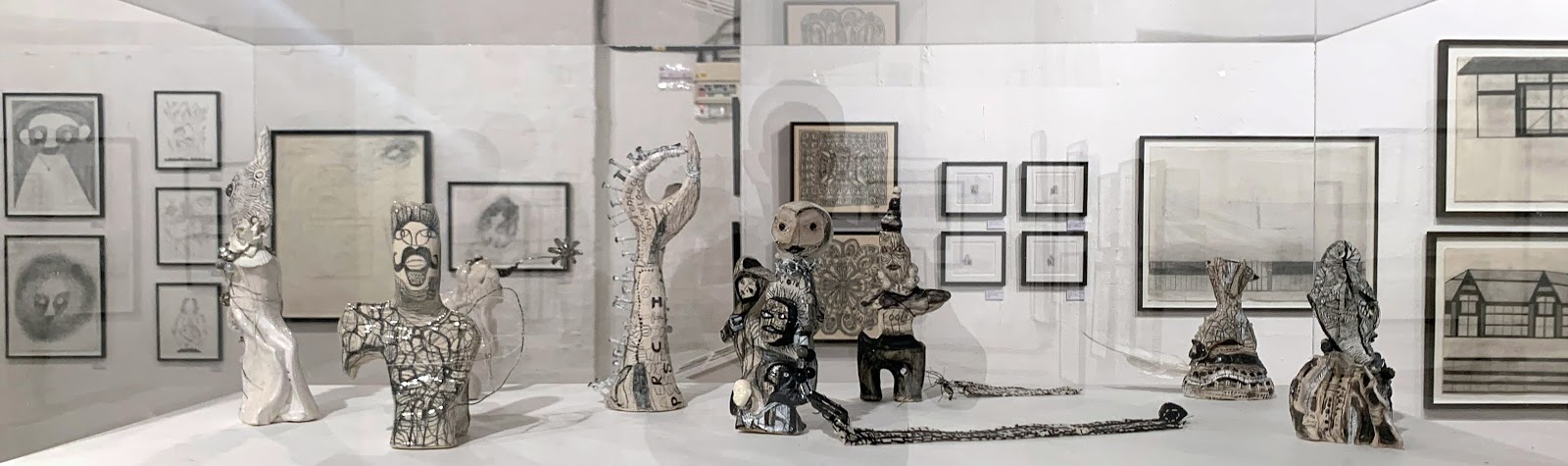
Monochromatic Minds installation view, including works by Terence Wilde
Monochromatic Minds is the latest venture of the peripatetic Jennifer Lauren Gallery. This ambitious exhibition, featuring 61 artists and around 150 works could be seen recently at Candid Arts Trust, London. The premise of the show was disarmingly simple; a selection of black and white art made by artists who have at times been gathered under the rubric of outsider art. The result, however, was a sophisticated system of compelling art that transformed the gallery space into an energetic, thought-provoking and highly intellectually satisfying visual conversation.


Works by Julia Sisi and introductory wall text

It is all too easy for an exhibition containing as many artists as this, and who come, moreover, from a wide range of lived contexts, to descend into visual incoherence. “Monochromatic Minds” does not. Cohesion is gained through curatorial restriction to the inclusion of monochrome works and essentially to drawings (even the relatively few three-dimensional objects in the show are essentially essays in the drawn mark). There is also a tendency toward a very shallow picture space in all the two-dimensional works included, which also assists the visual logic.


Monochromatic Minds installation view, with works by Albert (left) and Mami Yoshikawa (right)

Work in the show ranges from the boldly emblematic – Davood Koochaki, James Alison, Liz Parkinson – to densely worked, near claustrophobic essays in detail – Carlo Keshishian, David Abisror, Leslie Thompson, Chris Neate. It also collectively runs the gamut of techniques of conscious abandonment so beloved of the surrealists, from automatic drawing and writing – Malcolm McKesson, Julia Sisi, Dan Miller, Harald Stoffers, Beverly Baker, Cathy Ward – to mediumism – Madge Gill, Agatha Wojciechowsky – and visionary perception – Raymond Morris, Nick Blinko, Ody Saban. Visual Symbols dredged from the unconscious, whether through dream or imagination, are also commonly present, from Evelyne Postic and Margot’s tumescent organic images, to Jane Davigo’s suggestive symbolic narratives and Olivier Daunat’s remarkably spatial, yet airless, precise urban universes.


Beverly Baker, Untitled, 1998, ballpoint pen on paper (Latitude Arts)

Monochromatic Minds installation view, with works by, l to r Chris Neate, Cathy Ward, Evelyne Postic (top and bottom), Margot (middle), David Abisror

At times images arise from the experience of pareidolia, or a process of seeing-in to the figurative content of objects, as in Mehrdad Rashidi’s manipulated photographs and Gwyneth Rowlands’ flint figures. A near-automatic methodology and use of the suggestiveness of materials and emotion characterises Terence Wilde’s mixed media miniatures. Just about everything in the show seemed to be driven by an active process of evolution and growth, rather than some preconceived compositional conceit. Blinko’s exquisite drawings unfold, so to speak, only to be threatened by the weight of detail that packs the picture space, so that the whole is held in the most precarious of visual balance; a metaphor perhaps of human hovering between life and death. Indeed, in the case of two untitled figure drawings by the late Nigel Kingsbury, it is hard to say whether we are experiencing a smoky coming-into-being or a gentle, diaphanous dissolution of form.


Nick Blinko, Untitled, 2019, pen and ink

Nick Blinko, Crucilivas Arborilus, 2018, pen and ink

Nigel Kingsbury, Untitled, nd, pencil (ActionSpace)
One of the satisfying aspects of “Monochromatic Minds” is that it restricts itself neither geographically nor temporally in making its aesthetic choices – fourteen nations are represented here in a timescale that stretches from the present to around eighty years ago. In this way, the curator, Jennifer Gilbert was able to choose works that invited close individual attention by viewers and also consideration as a group in the liminal space of the gallery. Given the amount of planning and effort that had clearly gone into producing this project, which also included public artist talks, a short film and a published catalogue, it seems a shame that it ran for such a tantalisingly short time. I have no doubt that it will remain fresh in the minds of those who were lucky enough to see it for some time to come.

A catalogue is available, with an Introduction by Jennifer Gilbert and short essays by myself, Lisa Slominski and Judith McNicol, Manchester: Jennifer Lauren Gallery, 2020, 140pp, 73 col. and b&w plates, £10

https://www.jenniferlaurengallery.com/


Davood Koochaki

Leonhard Fink, Adam and Eve in Paradise, 2018, pencil
Malcolm McKesson (left) and Raymond Morris (right)
Agatha Wojciechowsky, Untitled, 1968, pen and ink


Monochromatic Minds installation view, including works by Ody Saban and Judith McNicol
Monochromatic Minds installation view

Friday, 16 August 2019

Shedding Light on Madge Gill's Art and Spirit

Artist and Spiritualist Madge Gill is an important figure in twentieth-century British art. Her work deserves to be much better known.

Madge Gill. Myrninerest, installation photo with ink drawing, William Morris Gallery

I spent the morning with Madge Gill. I finally read Vivienne Roberts’ excellent article to which Light devoted the whole of its June edition, and had a really good look at Madge Gill by Myrninerest, edited by Sophie Dutton, which was published to accompany the exhibition devoted to Gill's work  she curated at the William Morris Gallery, London.


Madge Gill is an artist in whose work I have long been interested. I even own a few pieces, all courtesy of the Henry Boxer Gallery, London https://www.outsiderart.co.uk/artists/madge-gill Her range of imagery is mesmerising and the scale of her visual art pieces moves from the near-miniature, on countless postcards, to large – and sometimes enormous – drawings on calico, five of which are can be seen in the William Morris Gallery show, including the breathtaking Crucifixion of the Soul (1934). Besides drawings, Gill also produced textiles and automatic writing, and examples of both are also included in Dutton’s book and exhibition.

Madge Gill, Crucifixion of the Soul (detail), 1061 x 147 cm, London Borough of Newham Heritage and Archives
In ‘The Art and Spirit of Madge Gill’, Vivienne Roberts develops a fully rounded picture of Gill’s life and character. She deals intelligently with Gill’s identification as a canonical outsider art figure and outlines her relationship to the artworld, both during her lifetime and after her death, demonstrating a continuum of sorts that has hitherto been downplayed. As is perhaps befitting to the context of the publication in which her article appears (‘a review of psychic and spiritual knowledge and research’) a little more than half of the text is devoted to Gill’s relationship to Spiritualism and esoteric subjects. Although this has been noted in the past, writers have tended to suggest that this was a passing interest or not particularly structured; a result of the trauma of losing two children and a kind of creative alibi. Roberts demonstrates not only that Gill and members of her family were deeply interested in psychic studies over a number of decades, but also that she was publicly involved, both as exhibiting artist and psychic. So, besides Gill’s submissions to the East End Academy exhibitions at the Whitechapel Gallery through the 1930s and 40s, we learn about her showing artwork in Spiritualist churches and her inclusion at an exhibition held as part of the International Spiritualist Congress in Liège, Belgium in 1922. As an introduction to Madge Gill's journey Roberts' article is an excellent contribution.

Madge Gill, Red Woman (detail), showing early stages of working (installation photo, Madge Gill. Myrninerest)
Madge Gill by Myninerest is really a compendium of images and text related to the artist, including contributions by Vivienne Roberts on Spiritualism, Sara Ayad on the importance of Gill’s doctor, Helen Boyle as supporter and, in some ways, protector. It includes reproductions of the work included in the William Morris Gallery exhibition, together with documentary photographs and reproductions of letters and historical texts, including the broadsheet, Myrninerest. The Spheres, published in 1926 by Gill’s eldest son, Laurie (also reproduced full-page by Roberts). There are also four loose leaf inserts – interviews with Sir Peter Blake, Michael Morgan, and Patricia Beger, whose collection of embroideries by Gill has only recently come to public light, and a series of photographs of the artist at work from 1947 by Edward Russell Westwood. As such, the book is a rich resource that serves as both Wunderkammer and, hopefully, stepping off point for further study and exploration.

Madge Gill, Untitled, colour wool embroidery, Collection de l'Art Brut, Lausanne (installation photo, Madge Gill. Myrninerest)
The exhibition itself, which continues at the William Morris Gallery, London E17 4PP, until 22 September 2019 https://www.wmgallery.org.uk/whats-on/exhibitions-43/madge-gill/ is well worth the visit. In some ways it is an assault on the senses. Sophie Dutton has amassed a substantial selection of important work, including the calico drawings, 18 drawings on card, a showcase containing Gill’s earliest known drawings, examples of automatic writing and postcard drawings, and 12 colour embroideries, including 10 owned by Patricia Beger (see layout diagrams and list of works at the end of this article). All of this is shoehorned into a single space. However, although given the option one might have curated the show over several rooms or in a much larger space, since Gill’s work itself is characterised by dense, shallow pictorial space and a horror vacui, there is something somehow fitting about this hang.

Installation photo, Madge Gill. Myrninerest, showing part of Wall 2 and wall 3
Installation photo, Madge Gill. Myrninerest, showing part of Wall 3 and Wall 4
My morning with Madge Gill left me feeling much better informed about the person and her life. It also got me thinking that there is much more to be said about her art itself. It has left me thinking that I need to go back to the actual works (rather than reproductions) to examine their physical construction and the creative means of their production. It has also left me wanting to investigate Gill’s iconography more deeply. Now that we have much more context for the life, it is perhaps time to engage head-on with the art.


Vivienne Roberts, 'The Art and Spirit of Madge Gill', Light, Vol. 140, June 2019
Sophie Dutton, ed., Madge Gill by Myrninerest, London: Rough Trade, 2019

Below: Exhibition layout and list of works