Sunday, 27 September 2020

Where are the Dadaists When You Need Them?

Thoughts on current museum culture

What a difference a decade and a half makes. An article published in today's Guardian online (1) couldn't be further away in approach and focus than another from 2004 ostensibly on the same subject, in the same newspaper. (2) The subject of both is Canadian American artist, Philip Guston (1913-1980). Titled, "An Everyday Genius", the earlier piece, by Sean O'Hagan, reviews the retrospective held at the Royal Academy of Arts, London 16 years ago. Today's article, by Edward Helmore, "Sense or censorship? Row over Klan images in Tate's postponed show", covers the announcement that a projected "major retrospective" of Guston's work, planned by four major international art museums has been postponed until at least 2024.

    O'Hagan's 2004 review focuses on Guston's artistic journey, providing context through the times in which he lived and his personal relationships. Crucially, and probably unsurprisingly, both the choice of illustration for O'Hagan's piece - Guston's famous self-portrait, The Studio (1969) - and his opening gambit focus on the celebrated abstractionist's return to figurative painting at the end of the 1960s: "In the Thirties, he had been a politically aware mural painter," O'Hagan tells us, "and now, 40 years later, he felt the need to respond once again to an America that was wearied by a long unwinnable war abroad and simmering social discontent at home; a country that was in the grip of a new conservatism." Sound familiar? Ironic, then, that backlash from the very people who are currently engaging in political struggle against the dominant (conservative and populist) ideology appears to be what the museums fear most.

    Those new paintings by Guston commonly included hooded figures that can be read as Ku Klux Klansmen. Or, says O'Hagan (and, I'd be more tempted to say), "something more personally emblematic: the masks that artists, like all of us, hide behind; the disguises we don to face or shy away from the world; the evil, banal and faceless, that lurks within us all." In other words, Guston's late paintings are richly complex and densely layered: in terms of their manifest and latent content (their intellectual content, if you will); and from the perspective of the way they operate as painting (their status as manufactured objects of visual culture). They are intensely political, but do not reveal their 'message' in crisp one-liners. Like all good poetry, Guston's figurative painting is allusive and multivalent; it demands the active (contemplative) attention of the viewer.

    This is something that the National Gallery of Art in Washington, the Boston and Houston Museums of Fine Art, and Tate Modern that have now announced the postponement of their planned "major retrospective" of Guston's work would agree with. The problem, it would appear, lies with the show's likely public reception. Thus, the "everyday genius" of O'Hagan's article is now rendered a dangerous commodity. Today's article is well-balanced and thoughtful but focuses (necessarily) not so much on the art as on museum politics and funding. It is a sad inditement of where things stand in the state of contemporary museum culture in the West. 

    Guston's work, in this is instance, is caught in the crossfire, so to speak; like so much other interesting and important art seems to be these days. At the centre of all of the bruhaha is an implicit presumption by the museums themselves that their audiences are incapable of contemplating art in thoughtful and sophisticated ways: Helmore quotes National Gallery of Art source, “There is a risk that [Guston's paintings] may be misinterpreted and the resulting response overshadow the totality of his work and legacy."  Moreover, this hypothesised audience is further infantilised by a perceived need to protect it from harm: "the museum wanted to avoid 'painful' experiences the imagery could cause for viewers." Dangerous work indeed!

    The museological impulse to 'inform' viewers about the ideas behind exhibitions and the works they contain really, through wall texts and audio guides, begins in earnest with the emergence of a 'new museology' in the 1970s and '80s, and a desire to better help inform and assist audiences in their apprehension and enjoyment of the museum experience. What was to be provided was interpretation; the impulse was neither to 'protect' sensibilities nor to appease particular, or multiple, entrenched viewpoints. Yet, it can sometimes seem like we have arrived at a point at which full-time, institutional curators believe that they are capable of producing didactic truths in their contextual texts and audio, drawn from a generally shared pool of theory and socio-historical belief that has ossified as dogma. 

    Realistically, there is an assumption among museum administrators and their curators that even those people who will not visit the museum have to be listened to. This is in no small part because public museums have come to be seen as symbolically important politically (not least because they have been increasingly forced to become a constitutive part of the 'leisure industry').  Thus, there is a nexus of groups that is interested in the symbolic identity of the museum and its function which, by means of their public behaviours and interactivities, either threaten or vouchsafe the museum's continued existence. Public museums rely on public money (tax dollars) and government patronage for their financial viability. In the US especially (though not exclusively), they also rely on the continued support (political and financial) of boards of trustees. Sponsorship by business is particularly important (nowadays often essential) for the realisation of special projects and individual exhibitions. And they rely on additional direct public funding, through ticket admissions and the sale of museum products. The withdrawal of any of these sources of patronage would endanger the continued viability of the institution. There is much at stake. And with the museum as political symbol having become, it seems, a legitimate target for political attack from all sides, with little evidence (at least if current mass media reports are anything to go by) of any side using it in a fundamentally supportive way, there is a real sense that the institution is endangered. To complicate things further, much current museum curatorial received wisdom is also inherently (and publicly) antagonistic to the institutions it serves - a political positioning that is at the very least double-edged. Little wonder that museum administrators tasked with maintaining financial viability and, put bluntly, political neutrality, find themselves in a truly divisive and unenviable position.

    To be fair, Helmore notes that Mark Godfrey, Tate Modern's Senior Curator of International Art, has said that the decision regarding the Guston retrospective "is actually extremely patronising to viewers, who are assumed not to be able to appreciate the nuance and politics of Guston’s works”. However, I suspect the issue at the heart of all this is the effect wrought by the mishmash of political fighting, both ideological and in the realm of realpolitik, that converge on the museum, its collections and exhibition practice. Competing groups outside the museum appear to be saying that its purpose is to tell us all what to think; 'goodthink', perhaps, to quote Orwell. The problem, of course, is that there is disagreement on exactly what that is. And the public museum's multiple stakeholder groups (that is, whether directly or indirectly, its funders) represent every one of these competing ideologies.

    Although it is perhaps understandable that much of the wider political battle is being waged with slogans and the blunt instrument of the dialectic, 'bumper sticker' criticism is surely not appropriate in the museum? And most especially in the case of works of art, which are, by their nature multivalent. A work of art cannot be reduced its definitive essence (or explained away, for that matter). This has been the common mistake of much academic art history and criticism (unlike literary criticism), which habitually looks past the work to engage with issues of intentionality, psychology, and the conditions of its production. Too often the work itself is rendered mute. But then, works of art don't 'speak' in simple phrases, and their valency is altered according to the time and place in which they are viewed, and by the subjectivity of each new viewer. As O'Hagan says, "Sinister, but oddly humorous too. Put simply, Guston's late paintings confuse and confound, disturb and dismay in equal measure; they are often vulgarly funny and utterly ominous." I'm not convinced that any amount of framing by “additional perspectives and voices” will neutralise the disturbing beauty of this particular body of work. What then?

    Faced with a far less accommodating dominant culture than currently prevails in the West, the Berlin Dada group used art as a weapon. They staged their own exhibitions, fully expecting the authorities to close them down. And, in due course, their revolt was appropriated and assimilated into the museum. Rather than watching an unedifying spectacle of public museums tying themselves in knots worrying whether they can possibly appease everyone with a stone to throw, it would be nice to think that new art was being utilised in the fights of today, created without public funding, and presented outside institutional contexts, and invading the dominant culture. Where are the Dadaists when you need them?


(1) Edward Helmore, "Sense or censorship? Row over Klan images in Tate's postponed show." The Guardian, 27 September 2020 theguardian.com/artanddesign/2020/sep/26/sense-or-censorship-row-over-klan-images-in-tates-postponed-show

(2) Sean O'Hagan, "An everyday genius." The Observer, 11 January, 2004 theguardian.com/artanddesign/2004/jan/11/art

Tuesday, 8 September 2020

Four Artists in Rotterdam

In and Out of the Frame

Galerie Atelier Herenplaats, Schietbaanstraat 1, Rotterdam, The Netherlands


Colin Rhodes


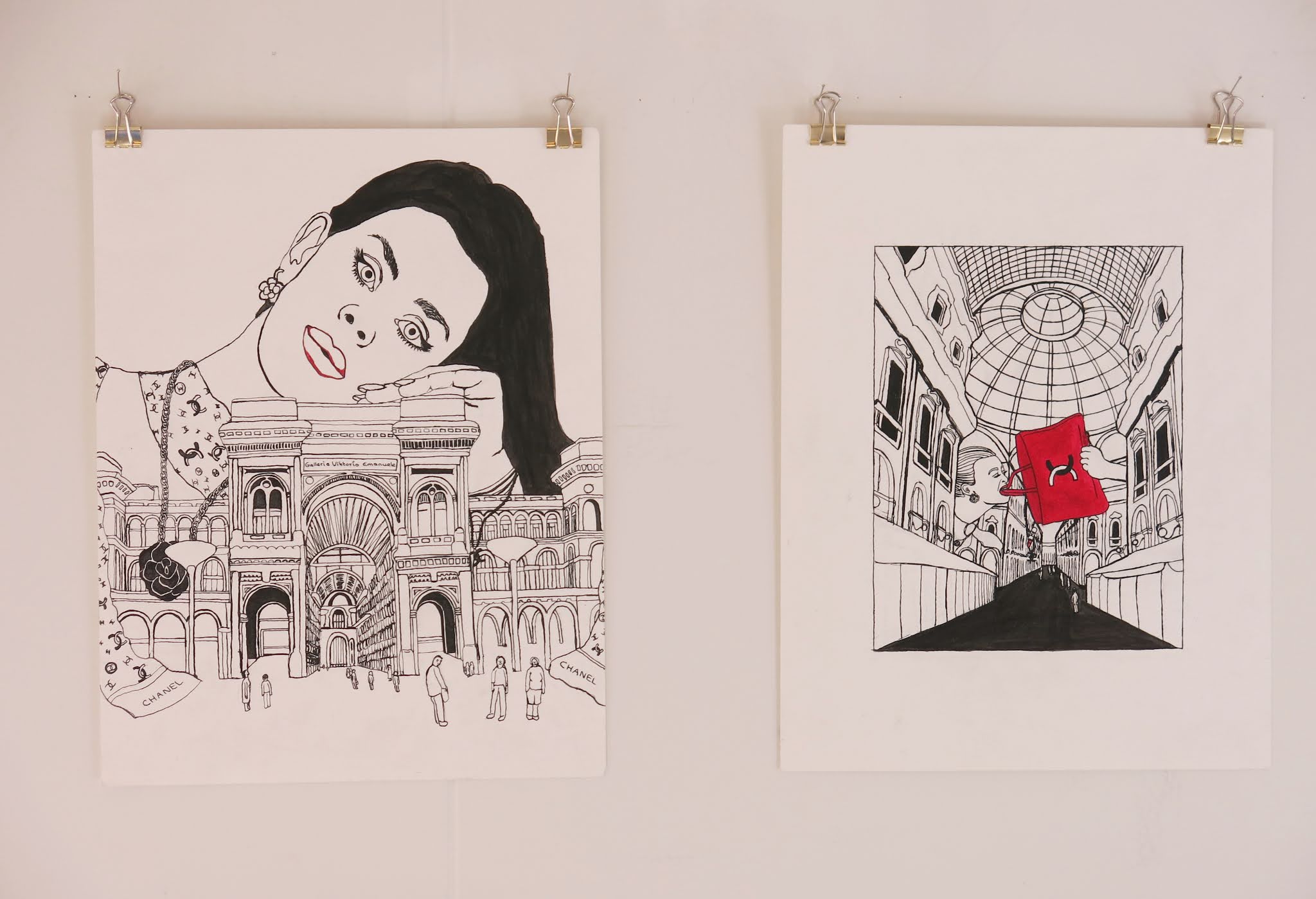
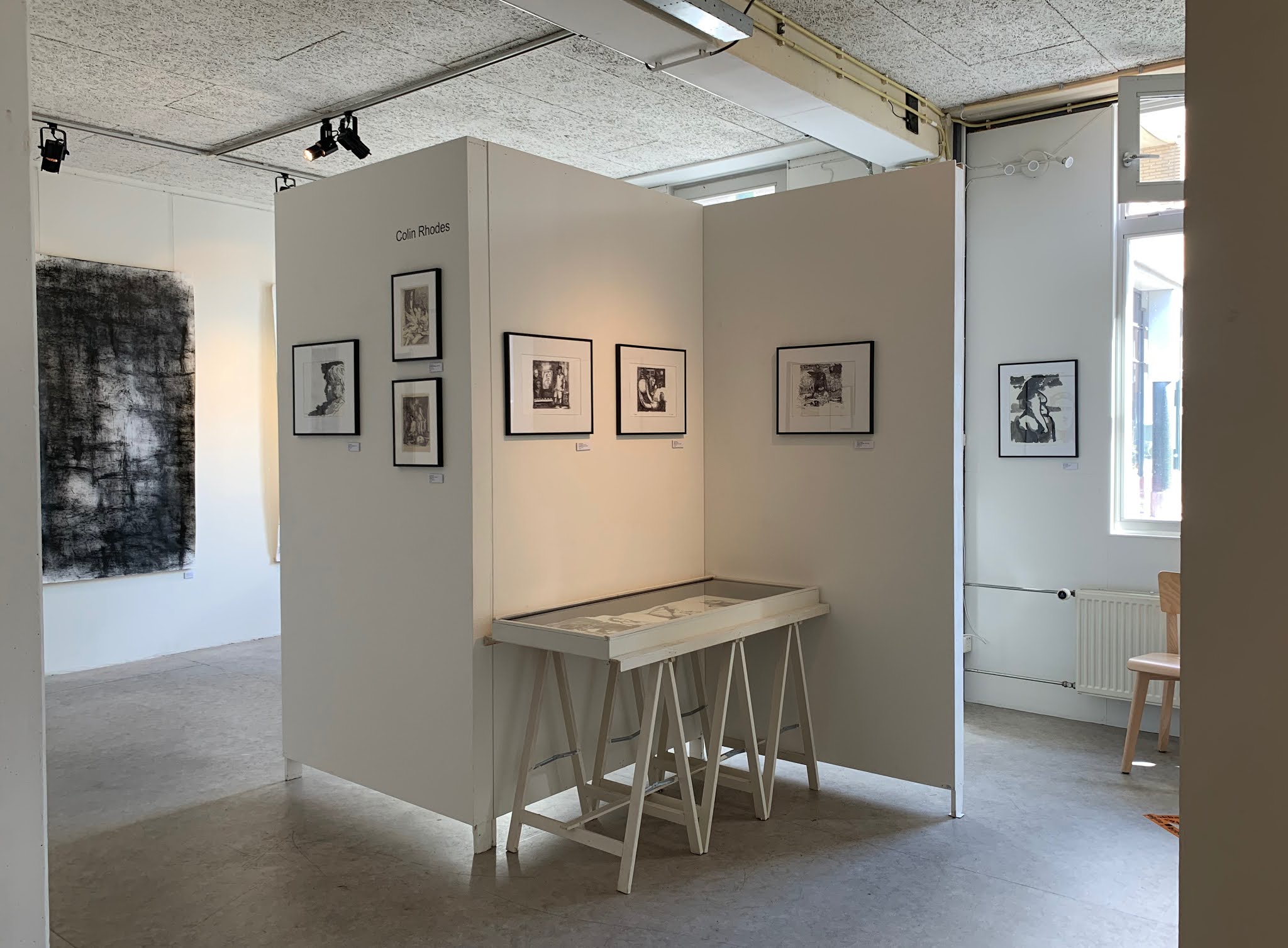
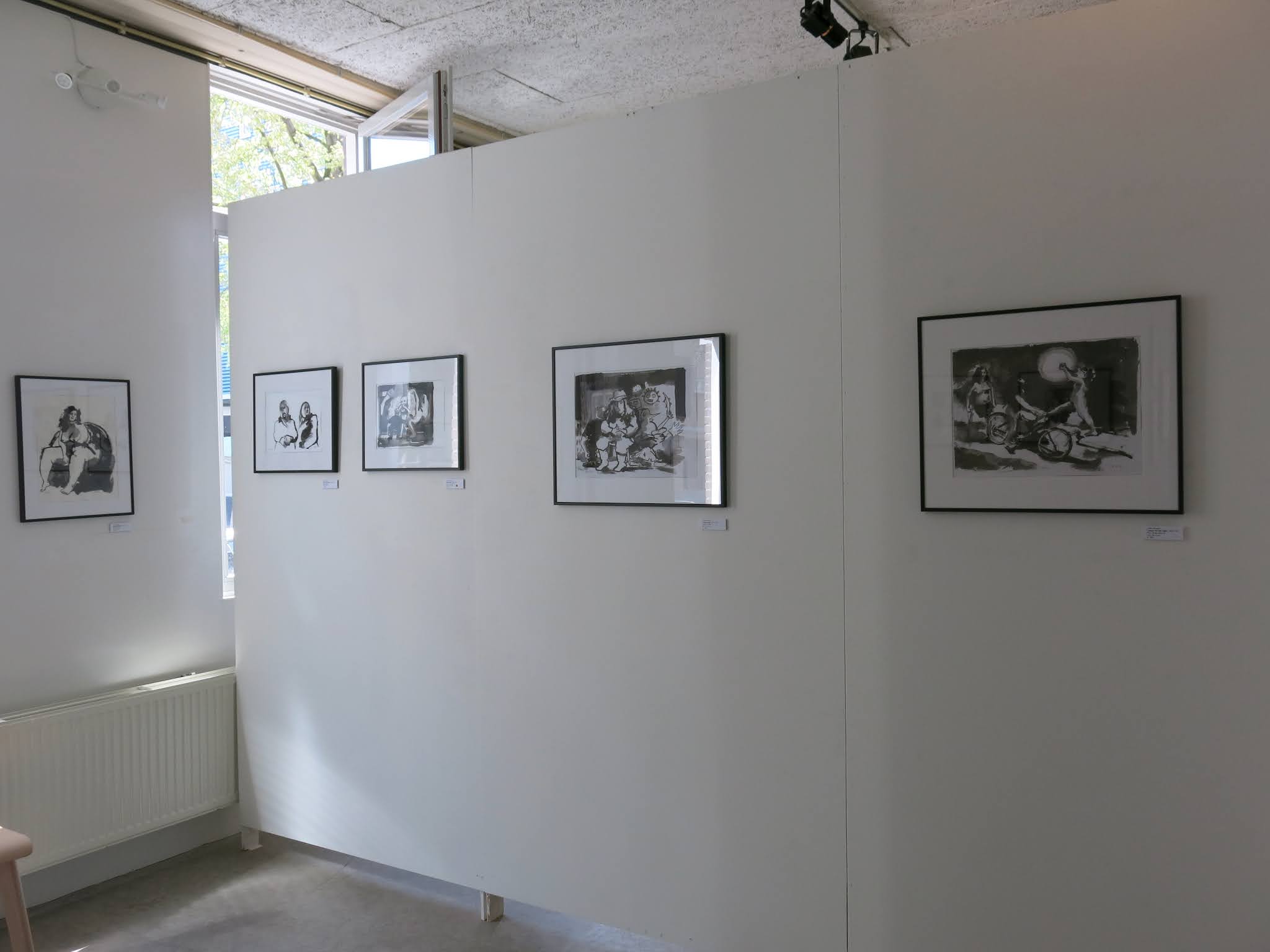
Last Friday saw the opening of In and Out of the Frame at Rotterdam's Galerie Atelier Herenplaats. Including more than 60 works by four artists, Anuja Hoogstad, Tim Soekkha, Richard Bennaars and myself. It was the first exhibition opening at the gallery since the beginning of the covid pandemic in The Netherlands, giving the event an added poignancy. It was great to see people turning out on the night to see the art and to mix with real people, as opposed to the eternal computer screen meetings we have all had to become used to (why do they call them 'virtual'? I see only necessity, not virtue). Of course, art that is made by hand and exists in physical form must be seen in real time and space. So, it was doubly pleasing for me to see the work of all four of us together in the gallery and viewers interacting with it. Online exhibitions are in no way a replacement for this; they are shadows, mere approximations that are not to be mistaken for the real thing. The online exhibition alone belongs in the dystopian descriptions of Debord and Baudrillard.

Anuja Hoogstad

In any case, these are all intimate works. Every artist here has poured themselves into the process of making and the resulting works are revelations of the psychologies and moods of each. In opening up in this way, they are trusting viewers to engage not objectively, by empathetically. This is as true of the sometimes dense, sometime tentative abstract mark-making of Richard Bennaars' paintings as it is of the precise, cool pen work of Anuja Hoogstrad, which operates through symbolic juxtaposition and gentle pareidolia. Tim Soekkha's drawings arise directly out of the experience of the way 2020 has thrown everyone back into an interior of sorts. They embody a crashing together of real experience and absurd encounter. I'll leave others to describe my work, except to say that everything here arises out of the cognitive process that only exists when mind, senses and physical movement trust to the demands of the materials of visual art.

Richard Bennaars and Colin Rhodes

The gallery card announcing the show can be seen in my previous post from 28 August, including information about artists and the concept

https://www.artschooltoartworld.com/2020/08/in-and-out-of-frame.html

Here are some installation photographs I made in the gallery, showing work by all of us. The exhibition can be seen until 14 November

Anuja Hoogstad


Tim Soekkha


Richard Bennaars


Colin Rhodes


Friday, 28 August 2020

In and Out of the Frame

Exhibition Announcement

In and Out of the Frame, Galerie Atelier Herenplaats

4 September - 14 November 2020


Very excited to announce that I am included in the forthcoming exhibition, In and Out of the Frame at Galerie Atelier Herenplaats, Rotterdam, The Netherlands. This is a four-person show, including artists Anuja Hoogstad, Tim Soekkha, Richard Bennaars and myself. I have more than 20 works in the show, all available for sale. Please contact the gallery for details.


Monday, 10 August 2020

Stephen Convey: Australian Visionary

 Stephen Convey and the Attraction of Place

My article on the Australian self-taught artist Stephen Convey was just published in French as 'Stephen Convey et l'attraction di lieu' in Création Franche, no.52, July 2020 - available at www.musee-creationfranche.com/
Stephen Convey's work will also be included in the annual invited exhibition, Visions et Créations Dissidentes at the Musée de la Création Franche, Bègles, France, 26 September 2020 - 10 January 2021
I publish a version of my article in English here for anglophone readers, including additional illustrations of the artist's work

Internal Dialogue, ballpoint pen and marker

The Australian artist Stephen Convey started making work in the mid-1970s. At that time, he was a wharf clerk on the Melbourne waterfront, a job that meant he spent a lot of time in dreary offices waiting for ships to arrive. As with some others before him, such as Scottie Wilson, he began drawing absent-mindedly in times of boredom. He soon realised that the act of drawing took him to another place. As he says, “I seemed to be able forget about time and become immersed in the moment.  I became fascinated by the images that seemed to flow out and it made the humdrum existence of work a lot easier to bear.” (Unless otherwise stated, all quotations are from communications with the author in spring 2020.) The urge to draw was not backed up by an artistic education. “I grew up without knowing art,” (Beier 17) he notes. However, although he never visited art galleries, there were books at home filled with images and his parents took him to museums sometimes. Most of the friends and work colleagues he has interacted with over the years have not been particularly interested in art. Entirely self-taught, his work has remained spontaneous and intuitive to this day. “I have no preconceived themes. Ninety-nine per cent of the time I just start,” he says (Beier 17). There are, though, recurring elements. The human figure, and in particular the face, is usually central, although sometimes stylised to the point of abstraction, and body parts, especially eyes, often crowd the picture space, commonly creating an effect of horror vacui. His oeuvre is also populated with strange, hybrid creatures; the spiritual forms of more mundane animals, perhaps. And there is a strong connection to place and the landscapes that he has known and inhabited, rendered symbolically and empathetically, rather than pictorially. In view of this, it comes as no surprise when he says, “The drivers for my work are that my art is an important extension of my self and my connection with the world.”

Untitled, ballpoint pen and marker


Convey was born in 1950 in the inner Melbourne suburb of Prahran. Now a rather trendy part of the city, during his childhood it was much more down to earth and significantly less developed. The young Stephen and his brother Tony, who is also an artist, regarded it as “a magical place,” filled with odd characters and interesting buildings, including derelict houses, from which the two of them collected old newspaper advertisements for movies that they found under the linoleum covered floors. The cinema was part of the magic, and equally the nearby Yarra River, which runs through Melbourne to the sea. As a young teenager, Stephen says he spent most of his time exploring Gardiners Creek, a tributary of the Yarra in nearby Glen Iris, where the family had relocated, “being fascinated by the natural world of frogs, eels, tortoises, and small native fauna.” He even remained close to the Yarra throughout most of his working life on the docks.


The Maze, ballpoint pen and marker


School was, for Convey, a largely unwelcome period of resisting attempts to force a conformism to which neither he nor his brother were suited: “The rigid discipline and dogmatic teaching didn’t appeal to me and by my teenage years girls and rock ‘n’ roll had taken a firm hold.” (Warner 37) He left school as soon as he was able and began a string of mostly labouring jobs. Before he settled into working on the docks, he hitchhiked to Sydney after reading Kerouac and the Beat writers, where he lived in Kings Cross, which at that time was notorious as the city’s clubland, gangland and home to society’s outcasts and dropouts. Back in Melbourne, working first in the railway yards, he was surrounded by an eclectic mix of people, including, “itinerants, musicians, junkies, alcoholics, writers, uni graduates and other assorted eccentrics,” (Warner 38) making for an enriching and often enjoyable experience. Music was, and remains, a hugely powerful, life-affirming experience, that both mirrors and finds expressive equivalences in his art. Over the years he has amassed an extensive and enviable record collection: “Music has always been a big influence on me: the rock ‘n’ roll of Little Richard, Buddy Holly, Jerry Lee Lewis and also the lonesome sounds of Hank Williams and Lefty Frizzel had a strong emotional effect. I have always been a seeker and started tracking down all influences on those people and many more. I realised this is a never-ending quest and one that I am still pursuing.”

Journey, acrylic, ballpoint pen and marker

While he rejects blind social conformity, Convey has strong personal ethics: “Images dredged from my inner world are my way of attacking the blandness of civilisation. McDonalds and Coca Cola are destroying individual cultures, turning us all into homogenised sameness. My journeys into my inner sea are my grasping for life and searching for deeper reality.” (Convey, S 3) Family has also played an important part in his life. He tells us, “I tried to instil in our children a love of nature and the mystery that life is. I used to take them on walks through parks and laneways and tell them it was the secret way.” Affinity with the natural world is strong. It is where, he says, “I feel most comfortable.” His brother remarks on Stephen’s strong attachment to Gardiners Creek and suggests that he “intuitively empathised with the original inhabitants whose stone tools lay buried under the grass.” (Convey, T 15) The attention he pays to place is always, therefore, fully sensory and intuitively immersive: “Country, as in nature, has a big impact on my art. I am always picking up different sorts of rocks, feathers, pieces of wood and seeds, and being amazed at the patterns. I suppose a lot of the symbols come from my belief that everything is connected.”

Flowing, acrylic, ballpoint pen and marker

In fact, Convey’s embrace of art making proper can be related to a kind of epiphany involving experiencing a powerful pantheistic intuition of nature as integral in a living, organic universe. As is often the case, this occurred at a difficult time in his life: “Work was really getting me down: I had nothing in common with the people I worked with. They were mainly relics from the ‘50s Cold War mentality and I was full of optimism and change. It was becoming harder and harder to keep going. I was continuing with the meditation and walking and starting to have weird experiences such as seeing ghosts and all sorts of spirit-like entities. Things were getting out of hand.” (Warner 38, 40) After one particularly powerful experience he relates, in which “magpies and wattle birds were talking to me” and  “the trees and plants were also communicating their inner thoughts to me,” Stephen found himself incarcerated for a couple of months in a “locked, overcrowded ward full of men and women swarming around praying, screaming, crying” in Melbourne’s old Larundel Psychiatric Hospital. After his release and return to work, he found himself drawing continually. “It seemed,” he says, “as if I had reached a place deep within myself that would stay with me forever, the primeval source if you like.” (Warner 40)

Heart of the Matter, ballpoint pen and marker


His methods rely on allowing images to rise to the surface from unconscious depths, as it were: “They just come out and flow out with my pen, marker or brush. I suppose it is similar to automatic writing, as it is completely spontaneous.” Precisely because of this Convey tends to use whatever materials are immediately available, although this does not always produce fully satisfactory results for him, as was the case with the very first works he made. Similarly, at times he has made drawings using fugitive materials that severely limit their lifespan. The first works he was fully satisfied with were made with Japanese Marvy makers that his wife, Suzie had suggested he use early on. Given the choice, he says, “I like to draw with Mitsubishi Uni-Ball biros and markers – whichever I can find. When I paint, I use acrylics, and use the brushes and their ends to sometimes draw with on the board or canvas.” The urge to make art is powerful: “I always take drawing books, biros, etc wherever I go,” he says, “I like to produce or start something every day. Otherwise I don't feel comfortable.”

The Talisman, ballpoint pen and marker

There are a number of recurring motifs in Convey’s work. Many images are dominated by a schematic human bust or face with figures contained within the overall form. Figures are also sometimes ranged across the shoulders of the main form. Vulvic shapes are also common elements, often serving as noses. The human form, whether complete or as constituent parts dominates his iconography. It is always, however, cast as a mythic presence in direct contact, and co-extensive, with the fecund forces of the universe, as is clear in Tuning In (below), which is redolent of some shamanic vision. Convey’s work abounds with references to energy and flow; there is a sense of things in motion and in the process of (presumably endless) transformation, mutation, development and diminution. Spirals are common elements, often in the form of ancient mythic snakes, and jagged triangles produce a feeling of almost iridescent energy, set against stars that are like synapse pulses revealing an organic universe of spectral presences.

Tuning In, ballpoint pen and marker

Although he has exhibited his work occasionally since 1988, Convey has never, as Beier put it, “sought exposure to his art, which puzzled or even irritated his friends. Art was to him a way to personal freedom.” (Beier 12) In other words, for Convey the emphasis is on the process of art making, rather than its dissemination. His art is also about understanding the self through the images that emerge. “It is important that I create images wherever I go,” he explains, “It helps me make sense of my existence.” Yet, he also regards his art as a communicating vessel: “A lot of the time I find it hard to communicate with people,” he told Beier, “So many things can’t be conveyed in words. There is so much inside anybody’s mind, there aren’t enough words in the language to say what we really feel. But in a drawing, I can put it all down precisely.” (Beier 18) Convey’s engagement with nature was thrown into relief around eight years ago when he had a liver transplant: “I was days away from dying when I was lucky enough to receive the gift of life,” he says, “Being so close to death has given me a better appreciation of the world around us and life in general.” And since then his artistic energies and production have not dimmed, but further intensified.

Balance, rollerball pen


References
Beier, Ulli. ‘Stephen Convey’, in, Outsider Art in Australia, Aspect no.35, 1989
Convey, Stephen. In Fifteen Australian Outsider Artists, Orange Regional Gallery, 1990
Convey, Tony. ‘Stephen Convey: The Hum of the Wheels and Wires’, in Outsider Art in Australia, Aspect no.35, 1989
Warner, Sandra. Australian Naïve Art, Sydney, 1994

Saturday, 7 March 2020

The Expressive Colour of Black and White Art

Monochromatic Minds: Lines of Revelation
Jennifer Lauren Gallery, at Candid Arts Trust, London
25 February – 4 March 2020


Monochromatic Minds installation view, including works by Terence Wilde
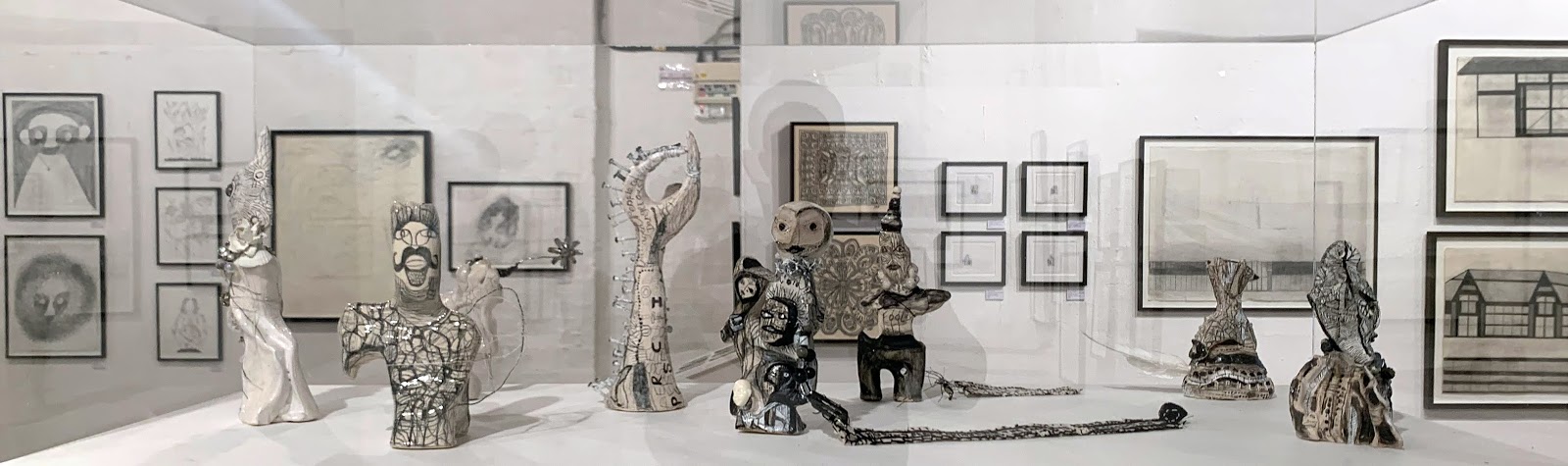
Monochromatic Minds is the latest venture of the peripatetic Jennifer Lauren Gallery. This ambitious exhibition, featuring 61 artists and around 150 works could be seen recently at Candid Arts Trust, London. The premise of the show was disarmingly simple; a selection of black and white art made by artists who have at times been gathered under the rubric of outsider art. The result, however, was a sophisticated system of compelling art that transformed the gallery space into an energetic, thought-provoking and highly intellectually satisfying visual conversation.


Works by Julia Sisi and introductory wall text

It is all too easy for an exhibition containing as many artists as this, and who come, moreover, from a wide range of lived contexts, to descend into visual incoherence. “Monochromatic Minds” does not. Cohesion is gained through curatorial restriction to the inclusion of monochrome works and essentially to drawings (even the relatively few three-dimensional objects in the show are essentially essays in the drawn mark). There is also a tendency toward a very shallow picture space in all the two-dimensional works included, which also assists the visual logic.


Monochromatic Minds installation view, with works by Albert (left) and Mami Yoshikawa (right)

Work in the show ranges from the boldly emblematic – Davood Koochaki, James Alison, Liz Parkinson – to densely worked, near claustrophobic essays in detail – Carlo Keshishian, David Abisror, Leslie Thompson, Chris Neate. It also collectively runs the gamut of techniques of conscious abandonment so beloved of the surrealists, from automatic drawing and writing – Malcolm McKesson, Julia Sisi, Dan Miller, Harald Stoffers, Beverly Baker, Cathy Ward – to mediumism – Madge Gill, Agatha Wojciechowsky – and visionary perception – Raymond Morris, Nick Blinko, Ody Saban. Visual Symbols dredged from the unconscious, whether through dream or imagination, are also commonly present, from Evelyne Postic and Margot’s tumescent organic images, to Jane Davigo’s suggestive symbolic narratives and Olivier Daunat’s remarkably spatial, yet airless, precise urban universes.


Beverly Baker, Untitled, 1998, ballpoint pen on paper (Latitude Arts)

Monochromatic Minds installation view, with works by, l to r Chris Neate, Cathy Ward, Evelyne Postic (top and bottom), Margot (middle), David Abisror

At times images arise from the experience of pareidolia, or a process of seeing-in to the figurative content of objects, as in Mehrdad Rashidi’s manipulated photographs and Gwyneth Rowlands’ flint figures. A near-automatic methodology and use of the suggestiveness of materials and emotion characterises Terence Wilde’s mixed media miniatures. Just about everything in the show seemed to be driven by an active process of evolution and growth, rather than some preconceived compositional conceit. Blinko’s exquisite drawings unfold, so to speak, only to be threatened by the weight of detail that packs the picture space, so that the whole is held in the most precarious of visual balance; a metaphor perhaps of human hovering between life and death. Indeed, in the case of two untitled figure drawings by the late Nigel Kingsbury, it is hard to say whether we are experiencing a smoky coming-into-being or a gentle, diaphanous dissolution of form.


Nick Blinko, Untitled, 2019, pen and ink

Nick Blinko, Crucilivas Arborilus, 2018, pen and ink

Nigel Kingsbury, Untitled, nd, pencil (ActionSpace)
One of the satisfying aspects of “Monochromatic Minds” is that it restricts itself neither geographically nor temporally in making its aesthetic choices – fourteen nations are represented here in a timescale that stretches from the present to around eighty years ago. In this way, the curator, Jennifer Gilbert was able to choose works that invited close individual attention by viewers and also consideration as a group in the liminal space of the gallery. Given the amount of planning and effort that had clearly gone into producing this project, which also included public artist talks, a short film and a published catalogue, it seems a shame that it ran for such a tantalisingly short time. I have no doubt that it will remain fresh in the minds of those who were lucky enough to see it for some time to come.

A catalogue is available, with an Introduction by Jennifer Gilbert and short essays by myself, Lisa Slominski and Judith McNicol, Manchester: Jennifer Lauren Gallery, 2020, 140pp, 73 col. and b&w plates, £10

https://www.jenniferlaurengallery.com/


Davood Koochaki

Leonhard Fink, Adam and Eve in Paradise, 2018, pencil
Malcolm McKesson (left) and Raymond Morris (right)
Agatha Wojciechowsky, Untitled, 1968, pen and ink


Monochromatic Minds installation view, including works by Ody Saban and Judith McNicol
Monochromatic Minds installation view

Tuesday, 3 December 2019

Vale Roger Cardinal

"Roger Leaving" by Colin Rhodes (ink on paper, November 2019)

Roger Cardinal will always be known as for his introduction of the term ‘outsider art’, conceived as an impressionistic attempt to create an anglophone equivalent for the French term, ‘art brut’, invented by the artist Jean Dubuffet in the 1940s. Ironically, as a linguist – Cardinal was fluent in French and German – he was comfortable with the French term. It was his publisher who insisted on inventing a new one for the history of the subject he published early in his career in 1972, for fear that an English and American market would not take to art brut. The term outsider art was taken up by dealers and collectors (many of them mainstream artists), especially from the end of the 1970s, and it came to embrace work from a much wider range of situations than Dubuffet envisaged. Cardinal always regretted this expansion and colonisation by a range of other sub-genres. He remained committed to his term, though, and continued to use it throughout his later writing on the subject, not least in his 1979 project with the art dealer Victor Musgrave for London’s Hayward Gallery, “Outsiders: an art without precedent or tradition.” It remained one of his few regrets that this major exhibition did not penetrate British culture more deeply or alter attitudes in universities towards its study as a serious subject.

Cardinal was far from one-dimensional in his interests. He had a lifelong passion for those areas of cultural production driven by ideas that fused the literary with the visual. He had a passion for Romanticism and made important contributions to scholarship on the subject. He wrote about Henry Moore, Paul Nash and Kurt Schwitters, and completed a manuscript on Prehistoric Art (as yet, unpublished). But it was probably his encounter with surrealism that most defined him, a movement to which he became enamoured while in Paris as a student of French at Cambridge University.

Roger in Margate, 27 November 2011
He wrote his PhD on surrealist constructions of love, and his book on André Breton’s Nadja appeared in 1984. His first book, which he wrote with Robert Short in 1970, was a little history of surrealism, and he was a regular participant at the surrealist conference gatherings at West Dean, the former home of the English poet and supporter of the movement, Edward James. It is fitting that he contributed the chapter on surrealism and outsider art to the important exhibition, “Parallel Visions: Modern Artists and Outsider Art” at the Los Angeles County Museum of Art in 1992.

Cardinal shared the surrealists’ love of marginalised things, and of the revelations and beauty produced by the operations of chance. I remember many walks with him, when he would suddenly divert us down some alley, or wander into a store for no other reason than they might reveal something of hitherto unknown interest. He would constantly point at little, unusual details, a mannerism, or an interaction between people across the street.

His entanglement with surrealism also led him to Dubuffet, who he met in Paris at the end of the 1960s and with whom he corresponded, and to art brut. Like all good surrealists, Cardinal was not a joiner of clubs and associations. This did not prevent him from being invited to contribute to numerous publications and to speak, especially on outsider art, across the world. His presence often acted as a catalyst for things to happen, which I’m not sure he was not entirely aware of. A flowering of outsider art in Australia, for example, that occurred in the mid-1980s was in no small part a result of his presence in the country on a brief fellowship at the Australian National University. He occasionally accepted formal positions, for example as a juror for Triennial of Naïve Art and as a member of the consultative committee of the Collection de l’Art Brut in Lausanne, and he was closely associated as contributing editor with the British outsider art magazine Raw Vision from its inception in 1989.


R C in profile by Colin Rhodes (ink on paper, 2017)
Cardinal’s intellectual interests and warm, generous manner stood him in great stead for his chosen career as an academic, most of which he spent as a teacher and researcher at the University of Kent, eventually as a professor. His dislike of bureaucracy and administration, however, meant that he neither sought nor accepted senior university positions and left him increasingly ill-suited to the managerialist culture of higher education that emerged towards the end of his career. It is important to remember the many generations of students that benefited from his teaching. He lived quietly in a little cottage near Canterbury, where he brought up two sons with his wife, Agnès, whom he met when they were both students. Roger was a most generous, gentle and hospitable person. Always happy to share his knowledge and to help others on their way. He was avuncular and sociable, liking nothing better than a day visiting galleries and wandering through city streets with a genial companion, punctuated by a pub lunch. Walks with Roger were never focused on a preconceived destination, but surrealist wanderings à la Breton and co. Side alleys were always more interesting than main streets, and random, discarded objects were often the impulse to assume a role. He endured large groups with equanimity, but preferred small gatherings, where his gentle wit sparkled brightest. He was a fan of jazz and an enthusiastic, if middling trumpeter. He also drew constantly, mostly on the folded sheets of paper on which he made copious notes for future use whenever the fancy took him. His books, too, tended to be heavily notated in his tiny, but beautifully legible script, with the language of notation matching that of the text. Roger was also an inveterate and assiduous diarist. There are many volumes reflecting not only his thoughts and experiences, but also the many places that he visited. These books are filled with collaged street maps, menus and other ephemera, providing an amazing picture of place, context and time. Any of us who touched his life somehow are in there, somewhere.

I have lost a dear friend, mentor and occasional sketching partner. He took me on many a surrealist ramble in places like Whitstable and Margate. We shared many a pub lunch. And we talked and talked about art and the artists we loved. There always seemed to be a book he owned that would fill a gap in my knowledge, or some acquaintance he had made that I would do well to look up. He was a gentle polymath and linguist; one of the most generous intellectuals I ever met. My heart goes out to Agnès. RIP Roger Cardinal (27 February 1940 - 1 November 2019).

Roger and Agnès Cardinal awaiting lunch at The Old Bell, Rye, 21 October 2017